Saint Paul as Missionary:
Focus on the Second Missionary Journey (Acts)
Page 1: Introduction – Saint Paul the Missionary
- Who is Saint Paul?
- Formerly Saul of Tarsus (Acts 9:1–2)
- A Pharisee and Roman citizen (Acts 22:3, 25–28)
- Dramatic conversion on the road to Damascus (Acts 9:3–19)
- Missionary Calling
- Chosen instrument to preach to Gentiles (Acts 9:15)
- Commissioned by the Holy Spirit (Acts 13:2–3)
- Overview of Paul’s Missionary Work
- Three major missionary journeys in Book of Acts
- Focus: spreading the Gospel beyond Jewish communities
- Purpose of the Paper
- Examine Paul as a missionary leader
- Analyze his Second Missionary Journey (Acts 15:36–18:22)
Page 2: Background to the Second Missionary Journey
- After the First Journey
- Return to Antioch (Acts 14:26–28)
- Debate over Gentile circumcision (Acts 15:1–2)
- The Jerusalem Council
- Decision: Gentiles not required to follow full Mosaic Law (Acts 15:6–29)
- Importance for missionary expansion
- Conflict Between Paul and Barnabas
- Disagreement over John Mark (Acts 15:36–40)
- Result: division into two teams
- Paul and Silas
- Barnabas and Mark
- Beginning of the Second Journey
- Strengthening churches (Acts 15:41)
- Revisiting previously established congregations
Page 3: Strengthening Churches and Timothy Joins
- Travel Through Syria and Cilicia
- Encouraging believers (Acts 15:41)
- Paul Meets Timothy
- In Lystra (Acts 16:1–3)
- Timothy’s mixed Jewish-Greek background
- Circumcision of Timothy for ministry effectiveness
- Delivering the Jerusalem Decree
- Instructions to churches (Acts 16:4–5)
- Result: churches strengthened and grew daily
- Mission Strategy
- Focus on discipleship and leadership development
- Flexibility for cultural sensitivity
Page 4: The Macedonian Call and Expansion into Europe
- Guidance of the Holy Spirit
- Prevented from preaching in Asia (Acts 16:6–7)
- Vision of the Macedonian Man
- “Come over to Macedonia and help us” (Acts 16:9–10)
- Entry into Europe
- Philippi as first major city (Acts 16:12)
- Conversion of Lydia
- A businesswoman (Acts 16:14–15)
- First recorded European convert
- Key Theme
- God directs mission work
- Expansion beyond Asia into Europe
Page 5: Ministry in Philippi – Persecution and Faith
- Deliverance of a Slave Girl
- Spirit of divination cast out (Acts 16:16–18)
- Paul and Silas Imprisoned
- Beaten and jailed (Acts 16:19–24)
- Miraculous Release
- Earthquake opens prison doors (Acts 16:25–26)
- Conversion of the Philippian Jailer
- “Believe in the Lord Jesus…” (Acts 16:30–31)
- Household baptized (Acts 16:33)
- Lessons
- Suffering as part of mission
- God’s power in adversity
Page 6: Thessalonica, Berea, and Athens
- Thessalonica
- Paul reasons in synagogue (Acts 17:1–4)
- Opposition arises (Acts 17:5–9)
- Berea
- Noble-minded listeners (Acts 17:11)
- Examined Scriptures daily
- Athens
- Paul’s sermon at the Areopagus (Acts 17:22–31)
- Addresses Greek philosophy and idolatry
- Mission Approach
- Contextual preaching
- Engaging different audiences (Jews vs. Greeks)
Page 7: Corinth and Conclusion of the Journey
- Ministry in Corinth
- Meets Aquila and Priscilla (Acts 18:1–3)
- Works as a tentmaker
- Opposition and Encouragement
- Vision from the Lord: “Do not be afraid” (Acts 18:9–10)
- Success in Corinth
- Many believe and are baptized (Acts 18:8)
- Return Journey
- Travels through Ephesus briefly (Acts 18:18–21)
- Returns to Antioch (Acts 18:22)
- Conclusion: Paul as a Missionary
- Faithful despite hardship
- Led by the Holy Spirit
- Pioneer of cross-cultural evangelism
- Overall Themes
- God’s sovereignty in mission
- Growth of the early Church
- Importance of perseverance
Conclusion Paragraph (for your paper)
Saint Paul’s Second Missionary Journey demonstrates his deep commitment to spreading the Gospel across cultural and geographical boundaries. Through guidance from the Holy Spirit, perseverance in suffering, and strategic ministry, Paul helped establish strong Christian communities throughout the Roman world. His work, recorded in the Book of Acts, continues to serve as a model for missionary activity today.
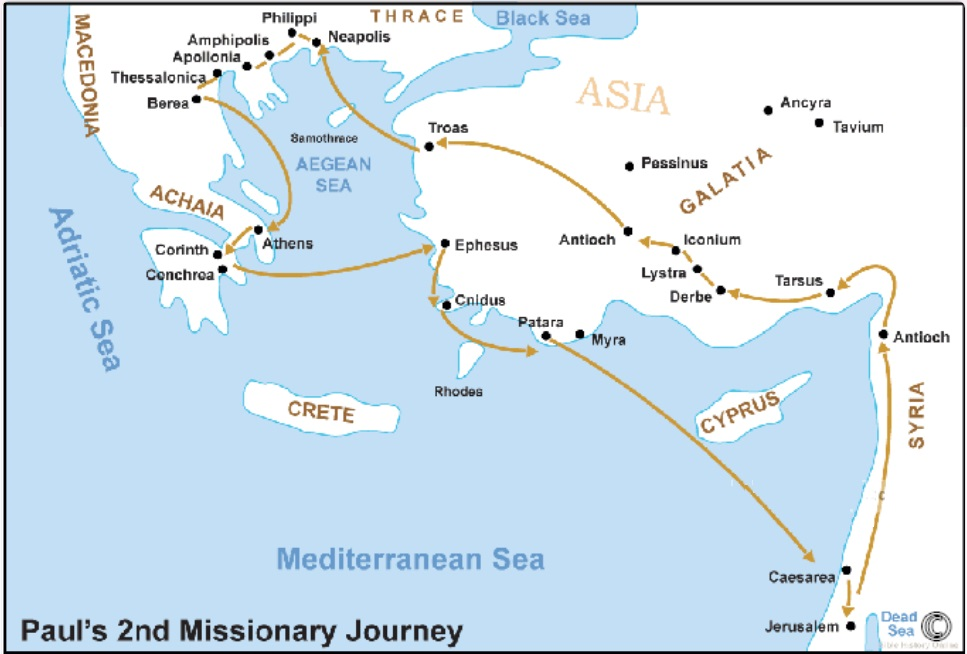
Saint Paul as Missionary: The Second Missionary Journey in the Book of Acts
Introduction
Saint Paul stands as one of the most influential figures in early Christianity. Originally known as Saul of Tarsus, Paul was a devout Pharisee who initially persecuted Christians (Acts 9:1–2). However, his dramatic conversion on the road to Damascus (Acts 9:3–19) transformed him into a devoted follower of Jesus Christ. From that moment forward, Paul became a passionate missionary, dedicating his life to spreading the Gospel, particularly among the Gentiles. According to Acts 9:15, God declared Paul to be a “chosen instrument” to carry His name before the nations.
The missionary work of Paul is largely recorded in the Book of Acts, which details the expansion of the early Church through the power of the Holy Spirit. Among Paul’s missionary journeys, the Second Missionary Journey (Acts 15:36–18:22) is especially significant because it marks the expansion of the Gospel into Europe and demonstrates Paul’s perseverance through trials and opposition. This essay examines Paul’s role as a missionary, focusing on the events, challenges, and impact of his second journey.
Background to the Second Missionary Journey
Before embarking on his second missionary journey, Paul had already completed his first journey, during which he established several churches in regions such as Galatia (Acts 13–14). Upon returning to Antioch, a major center of Christian activity, Paul became involved in a significant theological debate concerning whether Gentile converts needed to follow Jewish law, particularly circumcision (Acts 15:1–2).
This issue led to the Jerusalem Council (Acts 15:6–29), where the apostles and elders concluded that Gentiles were not required to fully observe the Mosaic Law. Instead, they were given a few essential guidelines. This decision was crucial because it removed a major barrier to Gentile conversion and allowed the Gospel to spread more freely across cultural boundaries.
Following this council, Paul proposed revisiting the churches they had previously established (Acts 15:36). However, a sharp disagreement arose between Paul and Barnabas regarding John Mark (Acts 15:37–39). As a result, they parted ways: Barnabas took Mark, while Paul chose Silas as his new companion (Acts 15:40). This division, though unfortunate, ultimately led to the multiplication of missionary efforts.
Paul and Silas began their journey by traveling through Syria and Cilicia, strengthening the churches (Acts 15:41). This marked the beginning of Paul’s Second Missionary Journey, characterized by both encouragement of existing believers and the establishment of new Christian communities.
Strengthening Churches and the Role of Timothy
As Paul continued his journey, he revisited cities such as Lystra and Derbe. In Lystra, he met a young disciple named Timothy (Acts 16:1–2), who would become one of his most trusted companions. Timothy had a Jewish mother and a Greek father, making him uniquely suited to bridge cultural gaps in ministry.
Paul decided to circumcise Timothy (Acts 16:3), not as a requirement for salvation, but as a strategic decision to avoid offending Jewish audiences. This demonstrates Paul’s flexibility and sensitivity in missionary work, as he later expressed in 1 Corinthians 9:20, becoming “all things to all people” for the sake of the Gospel.
As they traveled, Paul and his companions delivered the decisions of the Jerusalem Council to the churches (Acts 16:4). This helped unify believers and strengthen their faith. Acts 16:5 notes that the churches “were strengthened in the faith and grew daily in numbers.”
This phase of the journey highlights Paul’s commitment not only to evangelism but also to discipleship and leadership development. By mentoring individuals like Timothy, Paul ensured the continuation and stability of the early Church.
The Macedonian Call and Expansion into Europe
One of the most pivotal moments in the Second Missionary Journey occurred when Paul and his companions were guided by the Holy Spirit in an unexpected direction. According to Acts 16:6–7, they were prevented from preaching in certain regions, demonstrating that missionary work is ultimately directed by God.
Paul then received a vision of a man from Macedonia pleading, “Come over to Macedonia and help us” (Acts 16:9). Interpreting this as God’s call, Paul and his team immediately set out for Macedonia (Acts 16:10). This marked a significant turning point, as the Gospel was now being brought into Europe for the first time.
Their first major stop was Philippi, a Roman colony (Acts 16:12). There, they encountered Lydia, a seller of purple goods, whose heart the Lord opened to respond to Paul’s message (Acts 16:14–15). Lydia and her household were baptized, becoming the first recorded converts in Europe.
This section of the journey emphasizes the importance of divine guidance in mission work. Paul did not rely solely on his own plans but followed the leading of the Holy Spirit, resulting in the expansion of Christianity into new territories.
Ministry in Philippi: Persecution and Faith
While in Philippi, Paul encountered both success and opposition. He cast out a spirit of divination from a slave girl (Acts 16:16–18), which angered her owners because it deprived them of income. As a result, Paul and Silas were seized, beaten, and imprisoned (Acts 16:19–24).
Despite their suffering, Paul and Silas responded with prayer and worship, singing hymns to God while in prison (Acts 16:25). Their faith was rewarded when a sudden earthquake opened the prison doors and loosened their chains (Acts 16:26).
The jailer, fearing the prisoners had escaped, was about to take his own life, but Paul reassured him that everyone was still there (Acts 16:27–28). Deeply moved, the jailer asked, “What must I do to be saved?” (Acts 16:30). Paul replied, “Believe in the Lord Jesus, and you will be saved—you and your household” (Acts 16:31). The jailer and his family were baptized that very night (Acts 16:33).
This episode illustrates key aspects of Paul’s missionary character: unwavering faith, courage in suffering, and a commitment to sharing the Gospel even in the most difficult circumstances.
Thessalonica, Berea, and Athens: Diverse Responses to the Gospel
After leaving Philippi, Paul traveled to Thessalonica, where he preached in the synagogue (Acts 17:1–4). Some Jews and many Greeks believed, but opposition quickly arose, forcing Paul to leave (Acts 17:5–10).
In Berea, however, the people were more receptive. Acts 17:11 praises them for examining the Scriptures daily to verify Paul’s message. Many believed, demonstrating the importance of thoughtful engagement with the Gospel.
Paul then traveled to Athens, a center of Greek philosophy and culture. There, he delivered a famous sermon at the Areopagus (Acts 17:22–31), addressing the Athenians’ religious beliefs and introducing them to the “unknown God.” Paul skillfully connected the Gospel to their cultural context, even referencing their own poets.
Reactions in Athens were mixed—some mocked, while others were interested, and a few became believers (Acts 17:32–34). This highlights the varied responses missionaries may encounter and the need for adaptability in presenting the message.
Corinth and the Conclusion of the Journey
Paul’s next major stop was Corinth, where he met Aquila and Priscilla, fellow tentmakers (Acts 18:1–3). Paul worked alongside them while continuing to preach in the synagogue.
As opposition grew, Paul turned his focus more toward the Gentiles (Acts 18:6). The Lord encouraged him in a vision, saying, “Do not be afraid… for I am with you” (Acts 18:9–10). Strengthened by this assurance, Paul remained in Corinth for a year and a half, teaching the Word of God (Acts 18:11).
Many Corinthians believed and were baptized, including Crispus, the synagogue leader (Acts 18:8). Despite facing accusations before Roman authorities, Paul was ultimately protected, allowing his ministry to continue.
After leaving Corinth, Paul briefly visited Ephesus (Acts 18:18–21) before returning to Antioch (Acts 18:22), thus completing his Second Missionary Journey.
Conclusion
The Second Missionary Journey of Saint Paul reveals a powerful example of dedication, faith, and obedience to God’s calling. Through his travels, Paul strengthened existing churches.
|